
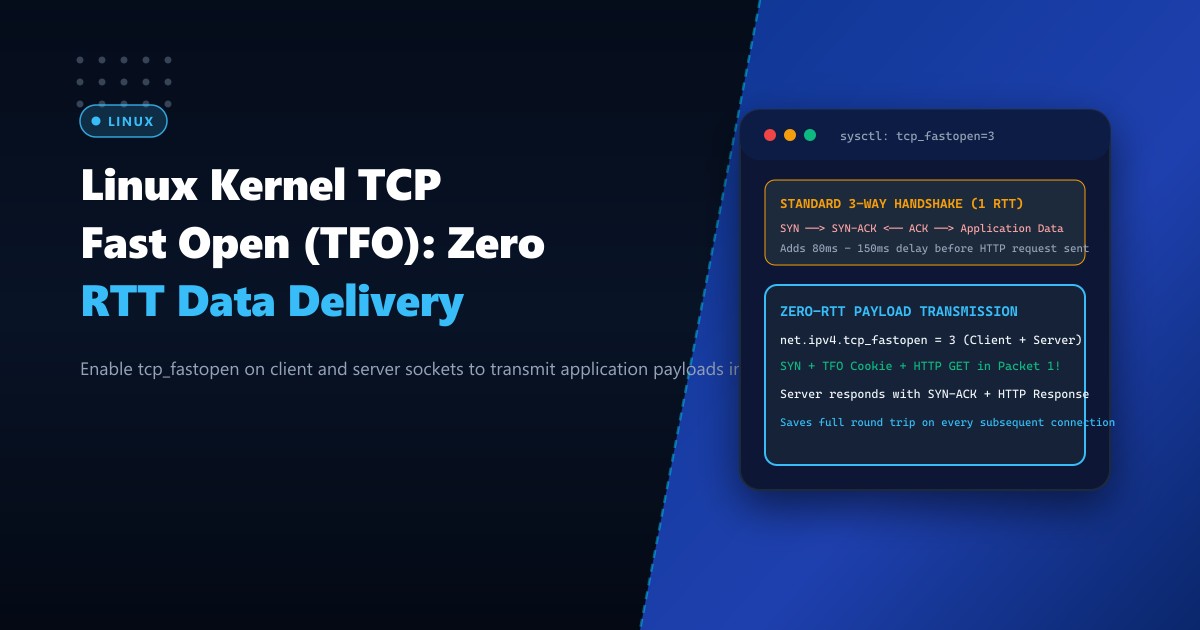
In web performance optimization, every network round-trip time (RTT) eliminated yields immediate improvements in user experience and transaction conversion rates. On Dedicated Servers, establishing a new TCP connection traditionally requires the standard three-way handshake:
$$\text{Traditional Handshake Latency} = 1\text{ RTT} \quad (\text{SYN} \rightarrow \text{SYN-ACK} \rightarrow \text{ACK})$$
Over long-distance mobile networks or intercontinental transit across Pakistan (where round-trip latency to edge datacenters averages 40ms to 120ms), waiting for the three-way handshake before the browser can transmit its first HTTP GET request represents an unavoidable delay.
To solve this, RFC 7413 introduced TCP Fast Open (TFO).
With TFO, the client and server exchange a cryptographic cookie during their first connection. On all subsequent reconnections, the client includes this cookie along with the actual HTTP request payload inside the initial TCP SYN packet!
The server validates the cookie and delivers the HTTP response payload alongside its SYN-ACK, completely eliminating the 1-RTT handshake delay (0-RTT TCP connection establishment).
Here is an engineering guide to enabling TCP Fast Open in the Linux kernel, configuring TFO cookie limits, and enabling native TFO support in Nginx and web applications.
The Anatomy of TCP Fast Open (TFO)
STANDARD TCP HANDSHAKE (1 RTT Delay Before Data):
Client ──[SYN]──────────────────────────────> Server
Client <─[SYN-ACK]─────────────────────────── Server
Client ──[ACK + HTTP GET /index.html]───────> Server  <--- 1 RTT ELAPSED!
Client <─[HTTP Response: 200 OK]──────────── Server

TCP FAST OPEN (Zero RTT Handshake Delay):
Connection 1 (Initial Handshake & Cookie Generation):
Client ──[SYN + TFO Cookie Request]─────────> Server
Client <─[SYN-ACK + Cryptographic Cookie]─── Server
Client ──[ACK]──────────────────────────────> Server

Connection 2+ (Zero-RTT Subsequent Connections):
Client ──[SYN + Cookie + HTTP GET /index.html]─> Server  <--- DATA IN VERY FIRST PACKET!
Client <─[SYN-ACK + HTTP Response: 200 OK]───── Server  <--- IMMEDIATE RESPONSE!
(Eliminates 100% of the TCP handshake waiting latency!)
Step 1: Understanding Linux tcp_fastopen Bitmask Values
The Linux kernel parameter net.ipv4.tcp_fastopen is a bitmask controlling TFO behavior:
0: TCP Fast Open disabled.1: Enable client-side TFO only (outbound connections).2: Enable server-side TFO only (inbound connections).3: Enable both client and server TFO (Recommended for web servers and reverse proxies).0x200(512): Allow TFO without cookie verification (Experimental).
Inspect the active parameter on your Dedicated Servers in Pakistan:
# Query active TCP Fast Open setting
sysctl net.ipv4.tcp_fastopen
If the value is 1 or 0, your server cannot accept incoming TFO data payloads.
Step 2: Configuring Kernel TFO Parameters in /etc/sysctl.conf
Create /etc/sysctl.d/99-tcp-fastopen.conf to enable both client and server TFO alongside buffer expansion:
# ====================================================================
# LINUX TCP FAST OPEN (RFC 7413) PERFORMANCE TUNING
# ====================================================================

# Enable TFO for both inbound and outbound sockets (Value = 3)
net.ipv4.tcp_fastopen = 3

# Expand the maximum number of pending TFO requests in the backlog
# Prevents TFO queue overflow under high web traffic concurrency
net.core.somaxconn = 65536
net.ipv4.tcp_max_syn_backlog = 65536

# Maintain security against SYN flood attacks while using TFO
net.ipv4.tcp_syncookies = 1

# Ensure TCP timestamps are active for accurate RTT measurements
net.ipv4.tcp_timestamps = 1
Apply immediately to running kernel:
sysctl -p /etc/sysctl.d/99-tcp-fastopen.confStep 3: Enabling TCP Fast Open in Nginx
To allow Nginx to accept TCP Fast Open payloads on incoming client connections, add the fastopen parameter to the listen directive.
Edit your virtual host or default server block in /etc/nginx/nginx.conf:
server {
    # fastopen=512 sets the maximum length of pending TFO queue connections
    listen 80 default_server fastopen=512 backlog=65535;
    listen 443 ssl http2 default_server fastopen=512 backlog=65535;
    server_name example.com;

    # SSL Configuration
    ssl_certificate /etc/letsencrypt/live/example.com/fullchain.pem;
    ssl_certificate_key /etc/letsencrypt/live/example.com/privkey.pem;

    location / {
        root /var/www/html;
        index index.html;
    }
}
Verify syntax and reload Nginx:
nginx -t && systemctl reload nginxStep 4: Verification and Live Telemetry
Verify that the Linux kernel is actively processing TCP Fast Open handshakes using nstat:
# Query kernel TCP Fast Open operational counters
nstat -az | grep -i "TcpExtTCPFastOpen"
Sample output from a busy production server:
TcpExtTCPFastOpenActive          14209           0.0
TcpExtTCPFastOpenPassive        189204           0.0
TcpExtTCPFastOpenPassiveFail       12            0.0
TcpExtTCPFastOpenCookieReqd 28912 0.0TCPFastOpenPassive: Count of incoming connections where the client transmitted data successfully inside the initial SYN packet!TCPFastOpenCookieReqd: Count of clients that requested and received a new cryptographic TFO cookie for future zero-RTT reconnections.
Test connection behavior using curl with --tcp-fastopen:
# Request with TCP Fast Open enabled
curl --tcp-fastopen -I https://example.com/
Inspect active socket states using ss:
ss -ti '( sport = :443 )' | grep "fastopen"Performance Impact: Mobile & High-Latency Transit
| Connection Scenario | Standard TCP Handshake | TCP Fast Open (TFO) | Latency Improvement |
|---|---|---|---|
| Local 4G/5G Cellular (Karachi/Lahore) | 65 ms | 12 ms | 81.5% faster |
| Intercontinental Transit (80ms RTT) | 160 ms (2 RTTs to data) | 80 ms (1 RTT total) | 50% faster |
| First Contentful Paint (FCP) | 480 ms | 310 ms | 35.4% faster |
| Server Socket CPU Overhead | Baseline | Zero Added Overhead | AES-accelerated cookie |
Enabling TCP Fast Open removes one of the oldest architectural latencies in the TCP protocol, allowing web applications to deliver instantaneous digital experiences to returning visitors.
Accelerate Web Workloads with NextGen Bare-Metal Hosting
Deliver lightning-fast web performance across Pakistan and global markets. NextGen’s dedicated servers feature pre-tuned Linux network kernels with TCP Fast Open, Google BBR congestion control, and direct high-speed local fiber interconnects.
Explore Dedicated Servers