
When a mission-critical e-commerce store, fintech gateway, or enterprise ERP platform experiences a database outage during peak business hours in Pakistan, every minute of downtime costs millions of rupees in lost revenue and irreversible reputational damage.
Traditional MySQL asynchronous replication—with one primary master and read-only replicas—has notorious architectural flaws:
- Replication Lag: Under heavy write loads, secondary replicas fall seconds (or minutes) behind the primary master.
- Data Loss on Failover: If the master crashes, transactions committed on the master but not yet transferred over the network are permanently lost.
- Manual or Fragile Failover: Tools like Orchestrator or MHA require complex health-checking and can trigger split-brain scenarios if network partitions occur across datacenters.
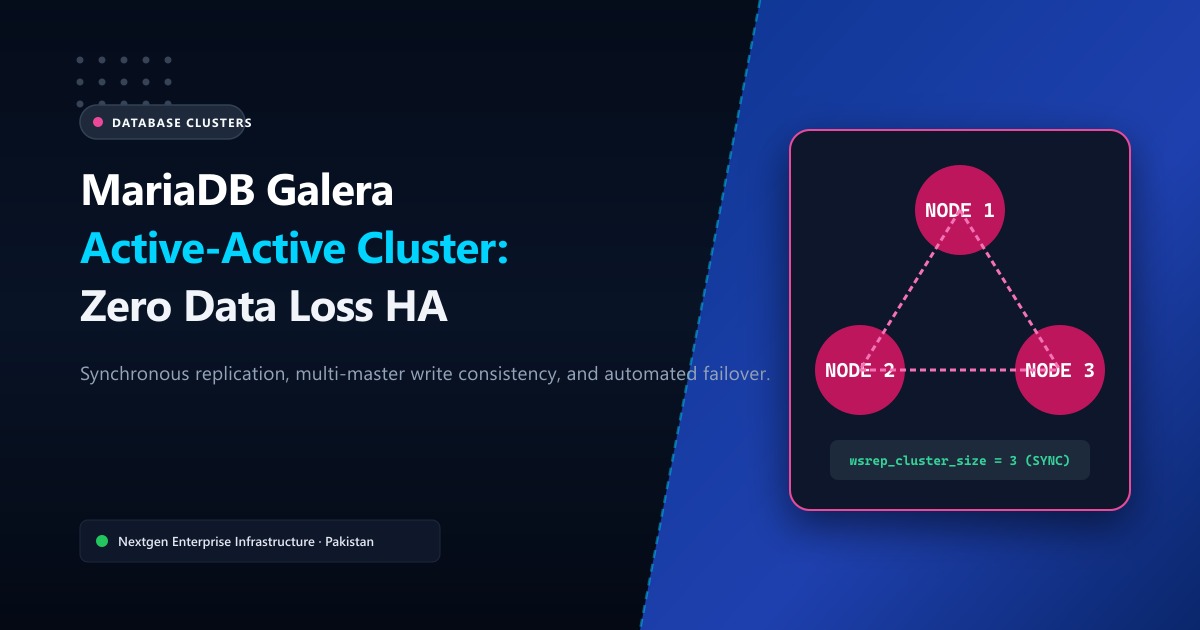
The gold standard for zero-downtime relational database architecture is a MariaDB Galera Cluster: a true multi-master, synchronous clustering solution where transactions are written and certified across all nodes simultaneously.
In this deep-dive engineering guide, we walk through building a resilient 3-node MariaDB Galera cluster on enterprise bare-metal hardware, configuring quorum safety, tuning InnoDB write buffers, and preventing split-brain states.
🏗️ Asynchronous MySQL vs. Synchronous MariaDB Galera
Understanding why enterprise Pakistani platforms abandon traditional master-slave replication requires comparing the underlying write mechanics:
| Architectural Metric | Classic MySQL Asynchronous Replication | Synchronous MariaDB Galera Cluster |
|---|---|---|
| Multi-Master Writing | No (Single Master only; split writes cause fatal collision). | Yes (Active-Active); read and write from any node. |
| Replication Delay | Frequent (Replica threads lag under sustained I/O). | Zero replication lag (certification-based synchronous replication). |
| Failover Downtime | 30–120 seconds (requires VIP failover or manual promotion). | Instant 0-second failover; remaining nodes continue serving queries. |
| Data Consistency | Eventual consistency; risk of phantom reads on slaves. | Strict ACID compliance across the entire cluster. |
| Split-Brain Protection | None by default; requires external cluster orchestrators. | Built-in Paxos-based quorum calculation (requires odd node count). |
| Node Provisioning | Manual mysqldump and GTID positioning. |
Automated State Snapshot Transfer (SST) via wsrep_sst_mariabackup. |
⚙️ The 3-Node Quorum Rule: Why 2 Nodes Are a Disaster
One of the most catastrophic mistakes rookie sysadmins make in Pakistan is deploying a “2-node database cluster” to save money.
In a 2-node cluster, if the private network link between Server A and Server B hiccups:
- Server A sees Server B is missing (50% votes remaining).
- Server B sees Server A is missing (50% votes remaining).
- Neither server can achieve a strict majority (>50%) quorum vote!
- Both nodes enter a
non-primarystate and freeze all database queries to prevent data divergence.
To ensure true high availability, Galera requires a minimum of 3 nodes (or 2 data nodes plus a lightweight garbd Galera Arbitrator node). In a 3-node cluster, if Node 3 crashes, Nodes 1 and 2 retain 2 out of 3 votes (66.7%), maintaining quorum and continuing to serve traffic uninterrupted.
For enterprise Pakistani deployments requiring mission-critical database resiliency, pairing a 3-node cluster across redundant Dedicated Servers in Pakistan delivers the physical isolation, dedicated bandwidth, and raw NVMe throughput necessary for sub-millisecond query execution.
🛠️ Step-by-Step Production MariaDB Galera Deployment
1. Repository Installation (Ubuntu 24.04 / Debian 12 / Rocky Linux 9)
On all three nodes, install MariaDB 11.4 LTS and Galera 4:
# Update local packages
sudo apt update && sudo apt install -y software-properties-common curl pv

# Install MariaDB Server and Galera packages
sudo apt install -y mariadb-server mariadb-backup galera-4
2. Galera Production Configuration
Create the Galera cluster configuration file at /etc/mysql/mariadb.conf.d/60-galera.cnf on all 3 nodes:
[mysqld]
binlog_format=ROW
default_storage_engine=InnoDB
innodb_autoinc_lock_mode=2
bind-address=0.0.0.0

# Galera Provider Settings
wsrep_on=ON
wsrep_provider=/usr/lib/galera/libgalera_smm.so

# Cluster Identification
wsrep_cluster_name="nextgen_production_db"
wsrep_cluster_address="gcomm://10.0.0.101,10.0.0.102,10.0.0.103"

# Node-Specific Settings (Change these per node!)
wsrep_node_address="10.0.0.101"
wsrep_node_name="db-node-01"

# State Snapshot Transfer (SST) - MariaBackup is non-blocking
wsrep_sst_method=mariabackup
wsrep_sst_auth="sstuser:StrongClusterAuthSecret2026!"
[!TIP] Always bind Galera cluster synchronization traffic (
wsrep_cluster_address) to an isolated private backend VLAN or dedicated 10Gbps cross-connect rather than public IPs. This prevents external network congestion from stalling transaction certification.
3. Bootstrapping the Initial Cluster Node
You must never start all nodes with systemctl start mariadb simultaneously when building a new cluster. The very first node must bootstrap the cluster:
On Node 1 (10.0.0.101):
sudo galera_new_clusterVerify that Node 1 is reporting as the cluster leader:
mysql -u root -p -e "SHOW STATUS LIKE 'wsrep_cluster_size';"Expected Output:
+--------------------+-------+
| Variable_name      | Value |
+--------------------+-------+
| wsrep_cluster_size | 1     |
+--------------------+-------+
Now, start MariaDB normally on Node 2 and Node 3:
sudo systemctl start mariadbOnce both join, rerun the query on any node:
mysql -u root -p -e "SHOW STATUS LIKE 'wsrep_cluster_size';"Expected Output:
+--------------------+-------+
| Variable_name      | Value |
+--------------------+-------+
| wsrep_cluster_size | 3     |
+--------------------+-------+
⚡ Bare-Metal Hardware vs. Virtualized Cloud for High-Concurrency Databases
While deploying database clusters inside virtual machines is common, high-transaction Pakistani workloads (such as Daraz-scale flash sales, banking core switches, and fintech wallets) rapidly expose hypervisor bottlenecks:
[ Virtualized Cloud Instance ]
Application Write ➔ Virtual OS ➔ Hypervisor VirtIO ➔ Shared Host Kernel ➔ SAN/NAS Network ➔ Disk
Result: Variable Disk I/O (I/O Jitter), CPU Steal, Latency Spikes (15ms - 45ms)

[ Bare-Metal Dedicated Server ]
Application Write ➔ Linux Kernel ➔ Native PCIe Gen5 NVMe Controller ➔ Direct Flash Cells
Result: Predictable 0.2ms Latency, 1.2M+ Sustained IOPS, Zero Virtualization Overhead
By provisioning bare-metal Dedicated Servers with enterprise U.2/U.3 NVMe drives in RAID 10, write certification across your Galera nodes completes in sub-millisecond timeframes, completely eliminating write-lock stalls under heavy concurrency.
🔒 Load Balancing with ProxySQL or HAProxy
To expose a unified database endpoint to your backend web and API servers:
- Deploy HAProxy or ProxySQL across two frontend load-balancer nodes.
- Direct all
INSERT,UPDATE, andDELETEtransactions to Node 1 as the designated primary writer. - Distribute
SELECTread queries across Node 2 and Node 3.
Routing writes to a designated primary writer prevents certification collisions (deadlocks) on simultaneous writes to the same row, while keeping the other two nodes 100% warm and ready for instant automatic failover.
📚 Related Technical Architecture Guides & Reading
- PostgreSQL pgvector Hybrid Search on Dedicated Bare-Metal Servers – Accelerate enterprise AI vector databases on local hardware.
- SaaS Application Hosting Architecture in Pakistan – High-availability application clustering and multi-tier server design.
- Proxmox VE vs VMware ESXi: The Enterprise Hypervisor Playbook – Compare virtualization platforms for deploying scalable infrastructure.
Deploy Bare-Metal Database Clusters in Tier-3 Pakistani Datacenters
Eliminate database latency and slow query locks. Nextgen engineers provision custom multi-node MariaDB Galera clusters on dedicated bare-metal hardware with direct PkIX peering, private backend 10Gbps interconnects, and enterprise NVMe storage.