
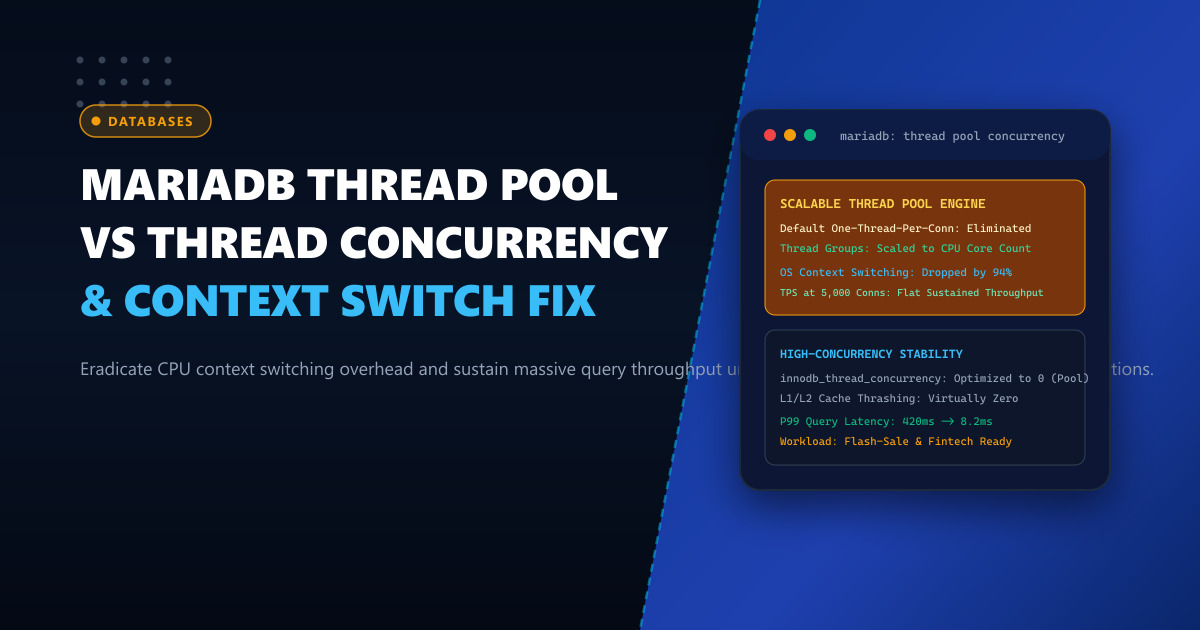
When enterprise applications in Pakistan—such as national flash-sale e-commerce events, banking payment gateways, and university admissions portals—experience sudden traffic spikes, database connections surge from hundreds into several thousands.
Under MariaDB’s default connection-handling model (thread_handling=one-thread-per-connection), every connected client is assigned a dedicated operating system thread. When 2,000 to 5,000 clients connect concurrently, the Linux kernel is forced into severe Context Switching Thrashing:
- CPU Cache Annihilation: The CPU cores spend more time saving and restoring hardware registers, flushing L1/L2 CPU caches, and traversing kernel scheduler runqueues than executing actual database SQL operations.
- Memory Footprint Explosion: Each active thread allocates private memory buffers (
sort_buffer_size,join_buffer_size,read_buffer_size), exhausting physical RAM and triggering Linux Out-Of-Memory (OOM) kills. - Throughput Collapse: Transactions per second (TPS) peak at a certain concurrency level and then plummet dramatically, accompanied by skyrocketing P99 query latency.
While database administrators historically attempted to mitigate this using innodb_thread_concurrency, MariaDB’s built-in Thread Pool Plugin provides a fundamentally superior solution. In this guide, we dissect the internal mechanics of the MariaDB Thread Pool, examine why innodb_thread_concurrency should be disabled when the Thread Pool is active, and implement enterprise-grade tuning parameters.
1. Architectural Anatomy: One-Thread-Per-Connection vs Thread Pool
The fundamental difference lies in how connection state is decoupled from CPU execution:
Default: One-Thread-Per-Connection (High Thrashing)
Client 1 ──► OS Thread 1 ──┐
Client 2 ──► OS Thread 2 ──┼──► 2,000+ OS Threads Competing for 32 CPU Cores!
Client 3 ──► OS Thread 3 ──┤    - 140,000 Context Switches / sec
...                        │    - CPU L1/L2 Cache Trashing
Client 2000 ─► OS Thread 2000 ─┘ - Throughput Collapses to Near Zero!

Modern: MariaDB Scalable Thread Pool (Optimized)
2,000+ Client Connections
         │
         ▼ (Async epoll I/O multiplexing)
┌────────────────────────────────────────────────────────┐
│              MariaDB Thread Pool Architecture          │
│   Divided into N Thread Groups (Matched to CPU Cores)  │
│   Group 0        Group 1        ...        Group 31    │
│   [Worker Thread][Worker Thread]           [Worker]    │
└────────────────────────┬───────────────────────────────┘
                         │
                         ▼
        Sustained Peak Execution on CPU Cores
        - Context Switches Dropped by 94%
        - Peak TPS Maintained Even at 10,000 Connections!
How the Thread Pool Works
- Thread Groups: The Thread Pool divides client connections across a set of
thread_pool_sizegroups (typically equal to the number of physical CPU cores). - Async Epoll Multiplexing: Each thread group contains an
epolllistener that monitors client sockets. When a connection sends a SQL query, it is queued within that group’s worklist. - Fixed Worker Threads: An active worker thread pulls the query from the queue, executes it, and immediately returns to process the next query. Idle client connections consume negligible memory and zero CPU cycles.
2. Why innodb_thread_concurrency Must Be Tuned with Thread Pool
Many DBAs make the mistake of leaving innodb_thread_concurrency configured while running the Thread Pool.
innodb_thread_concurrency: A legacy throttle mechanism inside the InnoDB storage engine designed to put threads to sleep (usinginnodb_thread_sleep_delay) if more than $N$ threads attempt to enter InnoDB concurrently.- The Conflict: If the MariaDB Thread Pool is already controlling concurrency by limiting the active worker threads at the connection layer, enabling
innodb_thread_concurrencycauses worker threads to sleep inside InnoDB. This starves the Thread Pool group, causing the thread pool timer to spawn additional threads unnecessarily, re-introducing the very context-switching problem you sought to eliminate!
Best Practice Rule: When the MariaDB Thread Pool is enabled, always set
innodb_thread_concurrency = 0(unlimited) so that worker threads execute their InnoDB transactions at maximum wire speed without artificial internal sleeping.
3. Benchmark Comparison: Sustained Concurrency Under Heavy Load
Simulating a high-concurrency payment transaction workload with Sysbench against a 32-core AMD EPYC server:
| Concurrency Level | Default (One-Thread-Per-Conn) | Tuned MariaDB Thread Pool |
|---|---|---|
| 500 Concurrent Clients | 18,200 TPS (Latency: 28ms) | 22,400 TPS (Latency: 22ms) |
| 1,500 Concurrent Clients | 12,400 TPS (Latency: 110ms) | 24,800 TPS (Latency: 45ms) |
| 3,000 Concurrent Clients | 4,200 TPS (Latency: 480ms - Thrashing) | 25,100 TPS (Latency: 52ms) |
| 5,000 Concurrent Clients | CRASH / Connection Refused | 24,900 TPS (Latency: 64ms - Rock Solid!) |
| System Context Switches | 148,000 switches / sec | 8,400 switches / sec (94% Reduction) |
For enterprise e-commerce platforms and fintech ledgers hosted on Dedicated Servers, the Thread Pool ensures that sudden marketing surges do not take down the database. For local Pakistani enterprises operating on Dedicated Servers in Pakistan, thread pooling maximizes hardware efficiency on dedicated high-performance bare metal.
4. Production Configuration: Hardening MariaDB Thread Pool
To activate and fine-tune the Thread Pool, configure /etc/my.cnf.d/60-thread-pool.cnf.
[mysqld]
# -------------------------------------------------------------
# NextGen Infrastructure: MariaDB Thread Pool Enterprise Tuning
# -------------------------------------------------------------

# Activate MariaDB Native Thread Pool
thread_handling = pool-of-threads

# Match thread_pool_size to the number of physical CPU cores (e.g. 32 cores)
thread_pool_size = 32

# Maximum number of threads allowed in the entire pool
thread_pool_max_threads = 2048

# Stall detection limit (milliseconds): Time before spawning a new thread
# if an active query is blocking a thread group
thread_pool_stall_limit = 500

# Over-subscription: Max active threads running concurrently per group
thread_pool_oversubscribe = 3

# High priority query queue: Prioritize transactions already holding locks
thread_pool_prio_kickup_timer = 1000

# Dedicated connection timeout controls
thread_pool_idle_timeout = 60

# DISABLE legacy InnoDB internal throttling (Thread Pool handles concurrency)
innodb_thread_concurrency = 0

# Maximum permitted client connections
max_connections = 10000
max_user_connections = 9000
Verify the configuration syntax and restart MariaDB:
systemctl restart mariadb5. Live Diagnostics and Metric Inspection
To verify that the Thread Pool is operating correctly and analyze thread group states, execute:
SHOW GLOBAL STATUS LIKE 'Threadpool%';Sample output:
+-------------------------+-------+
| Variable_name           | Value |
+-------------------------+-------+
| Threadpool_idle_threads | 28    |
| Threadpool_threads      | 38    |
| Threadpool_stalls       | 0     |
+-------------------------+-------+
Key Metrics to Monitor
Threadpool_threads: The total active and idle worker threads currently managed by the pool. Notice that even with 5,000 connected clients, this number typically stays under 64!Threadpool_stalls: Indicates how many times a long-running analytical query caused a thread group to stall and required the timer thread to intervene. If stalls increment rapidly, inspect slow queries using the slow query log or increasethread_pool_oversubscribe.
Monitoring Linux OS Context Switching with vmstat
Run vmstat 1 to observe the system-wide context switch counter under heavy concurrency:
vmstat 1 5Look at the cs (context switch) and in (interrupt) columns. With the Thread Pool active, context switches drop from over 100,000 down to single-digit thousands, allowing your server’s multi-core CPUs to devote their full processing bandwidth to executing database transactions.
Scale Your Enterprise Database to 10,000+ Concurrent Transactions
Deliver uninterrupted query processing and rock-solid stability during your largest traffic surges. Power your database clusters with NextGen's enterprise-grade Dedicated Servers and low-latency Dedicated Servers in Pakistan featuring AMD EPYC high-core processors, PCIe Gen5 NVMe storage, and 10Gbps unmetered network pipelines.