
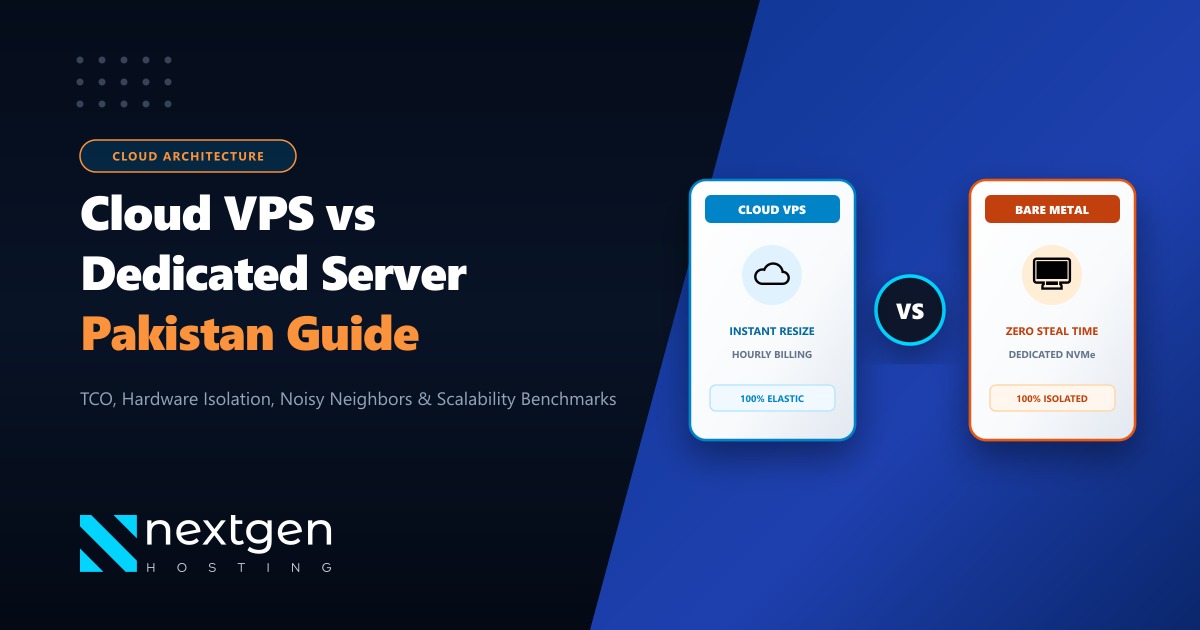
Every growing business in Pakistan reaches a critical crossroads in its digital infrastructure journey. You started out on affordable shared cPanel hosting, migrated to a 4-core or 8-core Virtual Private Server (VPS) when your daily visitors increased, and for a while, everything ran smoothly.
Then your company expanded.
Perhaps you launched an omnichannel retail brand, a high-frequency financial portal, a busy WordPress news publication, or a custom SaaS application for logistics. Suddenly, your team begins reporting intermittent slowdowns during peak midday business hours:
- API response times fluctuate wildly from 120ms to 4,500ms without code changes.
- Scheduled database backups freeze active user sessions.
- In terminal monitoring tools like
toporhtop, you notice a mysterious metric called%st(CPU Steal Time) spiking to 15%, 25%, or higher.
Should you upgrade to an expensive “mega-slice” 16-core or 32-core Cloud VPS, or is it finally time to move to a Bare Metal Dedicated Server?
In this definitive comparison, we cut through marketing buzzwords to analyze real benchmark telemetry, explore the hidden architectural tax of virtualization hypervisors, and calculate the exact mathematical break-even point where dedicated servers become both faster and significantly cheaper.
The Underlying Architecture: Hypervisor Slices vs. Bare Metal
To understand the performance discrepancy, we must examine how computing hardware is provisioned:
VIRTUAL PRIVATE SERVER (VPS)                 BARE METAL DEDICATED SERVER
┌─────────────────────────────────┐         ┌─────────────────────────────────┐
│ Your VM │ Tenant B │ Tenant C   │         │                                 │
├─────────────────────────────────┤         │    Your Operating System        │
│ KVM / VMware Hypervisor Layer   │         │       (Linux / Windows)         │
├─────────────────────────────────┤         ├─────────────────────────────────┤
│ Shared Host Kernel / CPU Queue  │         │ Direct Hardware Access (Zero VM)│
├─────────────────────────────────┤         ├─────────────────────────────────┤
│ Shared Physical Motherboard/RAM │         │ Dedicated AMD EPYC / Intel Xeon │
└─────────────────────────────────┘         └─────────────────────────────────┘
What is CPU Steal Time (%st)?
In a virtualized VPS environment, physical CPU cores are time-sliced across dozens of guest virtual machines using a hypervisor (such as KVM, Proxmox, or ESXi).
CPU Steal Time represents the percentage of time your virtual CPU (vCPU) wanted to execute an instruction, but was forced to wait because the physical hypervisor core was busy servicing another tenant on the machine.
If your VPS has 10% CPU steal, you are losing 10% of the raw computing power you pay for every single second. During massive shopping seasons or breaking news events when your noisy neighbors experience traffic surges, your server suffers through no fault of your own.
On a bare-metal machine, CPU steal is permanently 0.0%. You own 100% of the clock cycles. Explore our enterprise hardware lineups on Dedicated Servers and ultra-low latency nodes on Dedicated Servers in Pakistan.
Architectural & Performance Benchmark Comparison
Here is how an 8-Core Cloud VPS compares against an 8-Core Bare-Metal Dedicated Server running identical CentOS Stream 9 installations:
| Architectural Metric | Cloud VPS (8 vCPUs / 16 GB RAM) | Bare-Metal Server (8 Cores / 32 GB RAM) | Performance Delta |
|---|---|---|---|
| Sysbench CPU (Events/sec) | ~14,200 | ~26,800 | +88.7% Faster |
CPU Steal Time (%st) |
4.2% – 18.5% (Variable) | 0.0% (Zero) | 100% Deterministic |
| Random 4K NVMe Read IOPS | 35,000 (Throttled by Hypervisor) | 480,000+ (Native Direct PCIe) | 13.7x Faster I/O |
| Memory Bandwidth (Stream) | ~18 GB/s (Shared Memory Bus) | ~42 GB/s (Dedicated Quad-Channel) | 2.3x Faster Throughput |
| Disk I/O Latency ($\mu s$) | $1,200,\mu s - 3,500,\mu s$ | $85,\mu s - 140,\mu s$ | Up to 25x Lower Latency |
| Custom Kernel Modules | Restricted (e.g. Wireguard, XDP) | Full root control & IPMI/KVM | Complete Ownership |
Diagnosing Hypervisor Throttling on Your Current Server
If you currently suspect your VPS is being choked by noisy neighbors, run these three diagnostic commands in your SSH terminal:
1. Check Live CPU Steal Time
vmstat 1 10Look at the rightmost column labeled st. If values continuously exceed 3 to 5, your host node is severely oversubscribed.
2. Measure True Storage I/O Latency
ioping -c 10 .On a healthy enterprise bare-metal NVMe server, requests complete in sub-millisecond times ($<0.2\text{ ms}$). If your VPS reports 1.8 ms to 6.5 ms, your storage transactions are queuing behind other virtual machines.
3. Detect Hypervisor Clock Drift
dmesg | grep -i -E "clocksource|steal|kvm-clock"The Financial ROI Equation: When Does Dedicated Become Cheaper?
Many IT managers in Pakistan assume dedicated servers are exclusively for multi-million-rupee multinational corporations. In reality, modern pricing models make dedicated hardware more cost-effective once you cross modest utilization thresholds.
Consider a business needing 16 CPU cores and 64 GB of RAM:
Option A: High-End Cloud VPS (Overprovisioning Tax)
- Large cloud providers charge exponentially for high-tier compute instances.
- 16 vCPUs + 64 GB RAM Cloud VPS: ~$180 to $260 / month.
- Hidden addon costs: Egress bandwidth charges, snapshot storage fees, IOPS provision tiers.
- Total Annual Cost: ~$2,600 to $3,400.
- Result: You still share physical network cards and storage controllers with other users.
Option B: High-Performance Dedicated Server
- Dedicated AMD EPYC / Intel Xeon 8–16 Physical Cores (32 Threads) + 64 GB ECC RAM + 1TB Enterprise NVMe: Starting at ~$120 to $160 / month.
- Included unmetered bandwidth, dedicated IPv4 addresses, and full IPMI out-of-band management.
- Total Annual Cost: ~$1,440 to $1,920.
- Result: 35% to 45% annual cost savings while quadrupling your actual computing and I/O horsepower!
The 4 Warning Signs It Is Time to Upgrade
You should make the switch from a VPS to a Dedicated Server if your business matches any of these criteria:
- Traffic Threshold Exceeds 100,000 Daily Hits: At this volume, MySQL connection pools and PHP-FPM worker queues overwhelm virtualized memory buses.
- Regulatory & Data Compliance (SBP / SECP): Pakistani financial compliance rules increasingly mandate physical data isolation and verified local data residency.
- Database-Heavy Workloads: If your application relies on high-write transactions (inventory tracking, financial ledgers, booking engines), bare-metal NVMe arrays eliminate locking delays.
- Reseller Hosting Fleet Management: If you are an agency managing dozens of client cPanel or WordPress accounts, running them on a dedicated machine protects your brand from reputation-damaging outages.
Upgrade to 100% Bare Metal Dedicated Infrastructure
Stop paying the hypervisor tax and suffering from noisy neighbor lag. Migrate your high-growth Pakistani application to enterprise dedicated servers backed by unthrottled NVMe storage.