
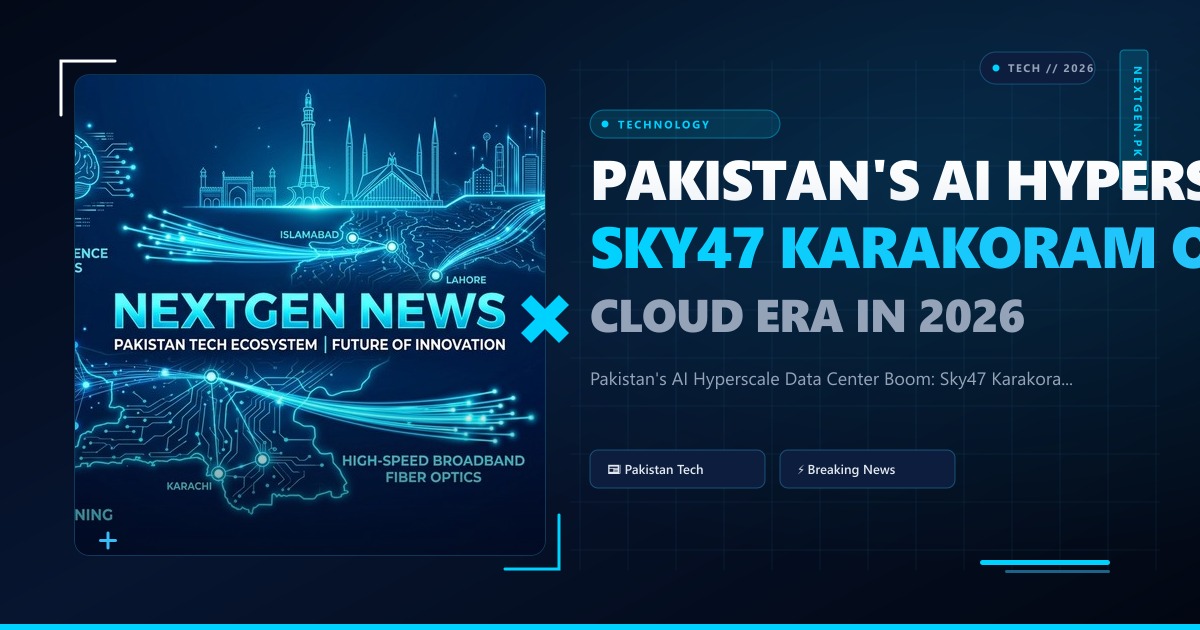
A deep technical analysis of Pakistan’s hyperscale AI data center revolution, liquid cooling architectures, microgrid power redundancy, and the Rise of Sovereign Cloud in 2026.
Pakistan’s enterprise technology and digital infrastructure ecosystem has entered a transformative era in late 2026. The convergence of the Digital Nation Pakistan Act 2026, rigorous data residency mandates from the State Bank of Pakistan (SBP), and soaring demand for localized high-performance computing (HPC) has catalyzed an unprecedented hyperscale data center boom across Islamabad, Lahore, and Karachi.
At the epicenter of this national transition is the launch of Sky47 Karakoram One in Islamabad—Pakistan’s largest AI-native, carrier-neutral Tier III/IV facility—alongside major expansions like the Quantum Global Data Centre in Karachi and technopolis hubs across Punjab.
This deep-dive architectural analysis examines the engineering, electrical, networking, and regulatory frameworks powering Pakistan’s sovereign AI cloud infrastructure in 2026.
1. The Engineering Challenge: High-Density AI Racks vs. Legacy Telco Facilities
Traditional colocation facilities in South Asia were engineered around telecommunications and standard web workloads, designed for modest power envelopes of 4 kW to 8 kW per rack.
Modern enterprise AI training, fine-tuning, and low-latency inference workloads completely break these legacy assumptions:
Thermal Management & Direct-to-Chip Liquid Cooling
In Pakistan’s diverse climate—where summer ambient temperatures in the plains routinely exceed 42°C—cooling high-density accelerated compute (e.g., clusters running NVIDIA Hopper/Blackwell or Huawei Ascend architectures) requires a fundamental shift from legacy air conditioning to closed-loop hydronic systems:
Deploying latency-sensitive machine learning models or containerized microservices? Discover Nextgen’s high-speed VPS hosting in Pakistan optimized for bare-metal performance and domestic throughput.
2. Power Resilience: Microgrids, BESS, and Dedicated 132kV Infrastructure
Power stability has historically represented the single largest operational friction point for digital infrastructure in Pakistan. The new generation of hyperscale facilities bypasses municipal grid volatility through hybrid private microgrid engineering:
3. Network Topology & Peering: Sub-12ms Intra-Country Routing
A world-class data center is only as powerful as its transit and interconnect fabric. Pakistan’s hyperscale ecosystem leverages significant advancements in national fiber backbones and peering exchanges:
Carrier-Neutral Interconnects and PKIX
Rather than relying on single-carrier captive routing, 2026 AI data centers operate open meet-me rooms (MMRs) directly peered with:
Latency Comparison: Domestic vs. Foreign Cloud Egress
For real-time financial settlement engines, conversational AI token generation, and biometric identity lookups, the 10x to 40x latency reduction offered by local compute is decisive.
4. Regulatory Drivers: Digital Nation Pakistan Act 2026 & SBP Compliance
The physical infrastructure buildout is reinforced by strong legislative mandates:
5. What This Means for Pakistani Startups and Enterprises
The democratization of local AI compute transforms Pakistan’s digital economy from a services exporter into a high-value product ecosystem:
Build Your Next-Gen Infrastructure Locally
Whether you are scaling a fast-growing SaaS startup, deploying a high-throughput e-commerce platform, or running specialized enterprise databases, Nextgen Hosting provides enterprise-grade infrastructure backed by local low-latency routing:
🛠️ Related Technical Architecture Guides
- Deep-Dive Diagnostics: Resolving Complex Database Latency in WordPress on cPanel/Linux – Enterprise implementation details and deployment guide.
- Enterprise Headless Browser Automation & Web Scraping on Cloud VPS: The Zero-Detection Architecture Guide – Enterprise implementation details and deployment guide.