
When shopping for high-performance servers in Pakistan, you will frequently see hosting providers boast about “Ultra-Fast NVMe SSD Storage”.
However, there is a dirty secret in the web hosting and cloud infrastructure industry: not all NVMe drives are created equal.
To slash hardware procurement costs, many budget hosting providers populate enterprise rackmount servers with consumer-grade desktop M.2 SSDs (such as consumer Samsung 980/990 EVO or Kingston NV2 drives designed for home gaming PCs).
While these consumer drives show impressive burst speeds on paper, deploying them in 24/7 enterprise production environments leads to silent data corruption, catastrophic thermal throttling, and premature drive failure within months.
In this technical whitepaper, we dissect the architectural differences between Enterprise U.2/U.3 NVMe SSDs and Consumer M.2 SSDs, and explain why true enterprise storage is non-negotiable for mission-critical databases and dedicated server infrastructure.
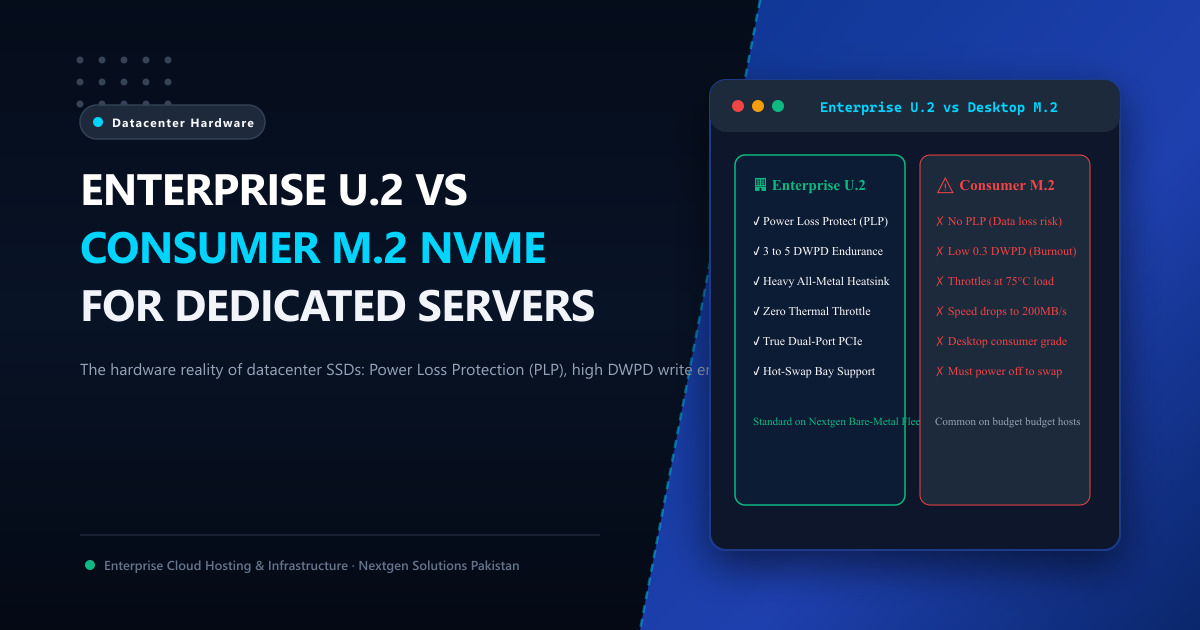
🔬 Architectural Comparison: Enterprise U.2/U.3 vs. Consumer M.2
| Hardware Metric | Consumer M.2 NVMe SSD (e.g., Desktop Drives) | Enterprise U.2/U.3 NVMe SSD (e.g., Kioxia CD8 / Micron 7450 / Samsung PM9A3) |
|---|---|---|
| Form Factor & Hot-Swap | Tiny M.2 gumstick; requires server shutdown and motherboard teardown to replace. | 2.5-inch SFF-8639 hot-swap chassis drive; replace live in 10 seconds without reboot. |
| Power-Loss Protection (PLP) | ❌ None (DRAM write-cache lost on power flicker; database corruption). | ✅ Full Hardware PLP (Tantalum capacitors flush all in-flight writes to NAND). |
| Drive Writes Per Day (DWPD) | 0.1 to 0.3 DWPD (Burned out within 6–12 months of database logging). | 1.0 to 3.0+ DWPD (Guaranteed for 5 years of continuous enterprise writes). |
| Sustained IOPS Performance | Drops by up to 80% once SLC pseudo-cache is exhausted. | 100% Deterministic Sustained IOPS across entire NAND capacity. |
| Thermal Dissipation | Prone to severe thermal throttling (>75°C) inside dense 1U/2U rack servers. | Heavy aluminum heatsink enclosure designed for high-CFM enterprise chassis airflow. |
| Uncorrectable Bit Error Rate (UBER) | 1 sector per $10^{15}$ bits read. | 1 sector per $10^{17}$ bits read (100x higher data integrity protection). |
⚡ 1. Hardware Power-Loss Protection (PLP): The Database Safeguard
For production databases running MySQL, MariaDB, or PostgreSQL, Power-Loss Protection (PLP) is the single most vital storage feature.
How Consumer Drives Fail During an Outage:
Consumer SSDs use volatile on-board DRAM to cache recent write operations before flushing them to permanent NAND flash chips. If an unpredicted power event occurs (such as a UPS transfer glitch or sudden kernel panic):
- The volatile DRAM cache immediately loses power.
- Any write transactions currently in flight are vaporized.
- Write-Ahead Logs (WAL) and InnoDB transaction logs become corrupted, leading to the dreaded
InnoDB: Database page corruption on diskerror, requiring hours of manual table recovery from backups!
How Enterprise U.2/U.3 Drives Protect Data:
Enterprise U.2/U.3 drives are engineered with physical tantalum capacitors integrated onto the printed circuit board (PCB). When power fails:
- Voltage sensors detect power loss in microseconds.
- The onboard tantalum capacitors release stored electrical energy, providing enough reserve power to flush the entire DRAM write cache safely into non-volatile NAND flash.
- Every committed transaction is 100% preserved with zero data loss or corruption.
📉 2. The Burst Illusion vs. Sustained Write IOPS
Consumer M.2 drive marketing relies on burst sequential benchmarks (e.g., “Up to 7,000 MB/s!”).
To achieve this number, consumer drives use a trick called SLC Caching: they treat a small portion of their TLC/QLC NAND as fast single-level cell cache.
- For the first 20GB to 50GB of data, writes are fast.
- Once that temporary SLC buffer fills up during heavy database indexing or large backup jobs, write speeds fall off a cliff—frequently dropping from 5,000 MB/s down to 300 MB/s, slower than an old SATA drive!
- Latency spikes from 50 microseconds up to several hundred milliseconds, freezing active database connections.
Enterprise U.2 NVMe drives do not use gimmicky SLC caching. They are calibrated for consistent, deterministic, and predictable sustained IOPS. Whether you write 1 Gigabyte or 10 Terabytes continuously, an enterprise U.2 drive delivers a flat line of 800,000+ random read IOPS and 250,000+ sustained random write IOPS around the clock.
🔥 3. Thermal Throttling in 1U & 2U Server Chassis
Server rooms and datacenters generate intense heat. Inside a compact 1U or 2U rackmount server, air is pulled through high-RPM cooling fans.
Consumer M.2 SSDs are tiny strips of silicon with virtually no surface area. When subjected to continuous read/write cycles:
- Drive controller temperatures quickly surpass 75°C to 80°C.
- The drive enters an aggressive internal thermal throttle mode to prevent self-destruction, cutting performance by 70% to 90%.
In contrast, Enterprise U.2/U.3 drives are housed in thick, ribbed cast-aluminum 2.5-inch enclosures that act as massive heat sinks. They interface directly with front-panel drive caddies, keeping operating temperatures safely below 45°C even under 100% full-duty write loads.
🔄 4. Zero-Downtime Hot-Swappability
What happens when a drive finally reaches its end-of-life or develops bad NAND blocks?
- With Consumer M.2: The drive is screwed directly onto the motherboard underneath PCIe expansion slots and CPU coolers. To replace it, sysadmins must power down the entire server, disconnect all power and network cables, slide the server out of the rack, unscrew the chassis lid, swap the gumstick, and reassemble everything. Estimated downtime: 45 to 90 minutes.
- With Enterprise U.2/U.3: The drive sits in a front-accessible, toolless hot-swap drive bay. The technician simply presses the release latch, pulls out the failed drive, slides in the replacement, and snaps the latch shut. The hardware RAID or ZFS mirror begins rebuilding automatically without a single millisecond of server reboot or service interruption!
🏆 Nextgen’s Commitment to Enterprise Storage Hardware
At Nextgen, we refuse to compromise on hardware integrity.
Our bare-metal Dedicated Servers in Pakistan and international Dedicated Servers are powered exclusively by genuine enterprise U.2/U.3 NVMe drives featuring:
- Full Hardware Power-Loss Protection (PLP) with high-grade tantalum capacitors.
- High-Endurance 1.0 to 3.0 DWPD ratings, tested for years of unrelenting enterprise database operations.
- Hot-swappable front drive caddies connected directly to PCIe Gen4/Gen5 backplanes.
📚 Related Technical Guides & Reading
- What is NVMe PCIe Gen5 Hosting and Why Does It Matter in Pakistan? – Deep dive into 14,000 MB/s PCIe bus architectures.
- NVMe RAID 10 vs RAID 1 for Database Performance: Which Should You Choose? – Benchmark comparisons for MySQL and PostgreSQL transaction throughput.
- What is Dedicated Hosting? Bare-Metal Benefits, Hardware Architecture & When to Upgrade – Complete breakdown of dedicated infrastructure vs virtualized cloud.
Upgrade to Pure Enterprise NVMe Bare-Metal Servers
Protect your databases from data loss, thermal throttling, and drive burnout. Deploy dedicated bare-metal servers configured with genuine Enterprise U.2/U.3 NVMe drives, hardware PLP, and Tier-3 Islamabad datacenter peering.