
If you operate a web hosting company, manage a digital marketing agency hosting dozens of client websites, or administer multi-tenant servers in Pakistan, your biggest operational nightmare is the “noisy neighbor” phenomenon.
On a standard Linux operating system (such as AlmaLinux, Rocky Linux, or Ubuntu Server), every tenant on the server shares the same physical memory space, CPU schedule, and disk I/O queues. If a single client site is hit by a sudden traffic surge, runs an unindexed recursive SQL query, or gets infected with a malicious cryptocurrency mining script:
- That single runaway script can consume 100% of the server’s CPU cores.
- Physical RAM exhausts, triggering the Linux Out-Of-Memory (OOM) killer to terminate Apache, MySQL, or Exim.
- All 200+ other websites hosted on that server crash simultaneously.
To solve this fatal architectural weakness, the hosting industry developed CloudLinux OS.
In this technical breakdown, we compare CloudLinux and vanilla AlmaLinux head-to-head, explore the mechanics of CageFS virtualized isolation, and explain why serious hosting providers in Pakistan treat CloudLinux as non-negotiable.
🥊 CloudLinux vs. AlmaLinux: Architectural Breakdown
| Architectural Feature | Vanilla AlmaLinux 9 / Rocky Linux | CloudLinux OS 9 |
|---|---|---|
| Licensing Model | 100% Free Open Source (RHEL downstream). | Paid Commercial License (~$14–$20/month per server). |
| Resource Isolation | None (All users share the global process pool). | LVE (Lightweight Virtual Environment) per cPanel user. |
| Filesystem Security | Standard Unix file permissions (Risk of symlink attacks). | CageFS Virtualized User Jail (Users cannot see other tenants). |
| Database Protection | MySQL can be overwhelmed by one runaway user query. | MySQL Governor throttles rogue database queries in real-time. |
| PHP Version Flexibility | Dependent on system packages or MultiPHP modules. | HardenedPHP (Secure, patched legacy PHP runtimes from 5.6 to 8.3). |
| Ideal Deployment | Single-purpose application servers, Docker hosts, private VPS. | Multi-tenant shared hosting, reseller hosting, agency fleets. |
🛡️ Deep Dive: The 4 Pillars of CloudLinux Security
1. CageFS: The Virtualized Chroot User Jail
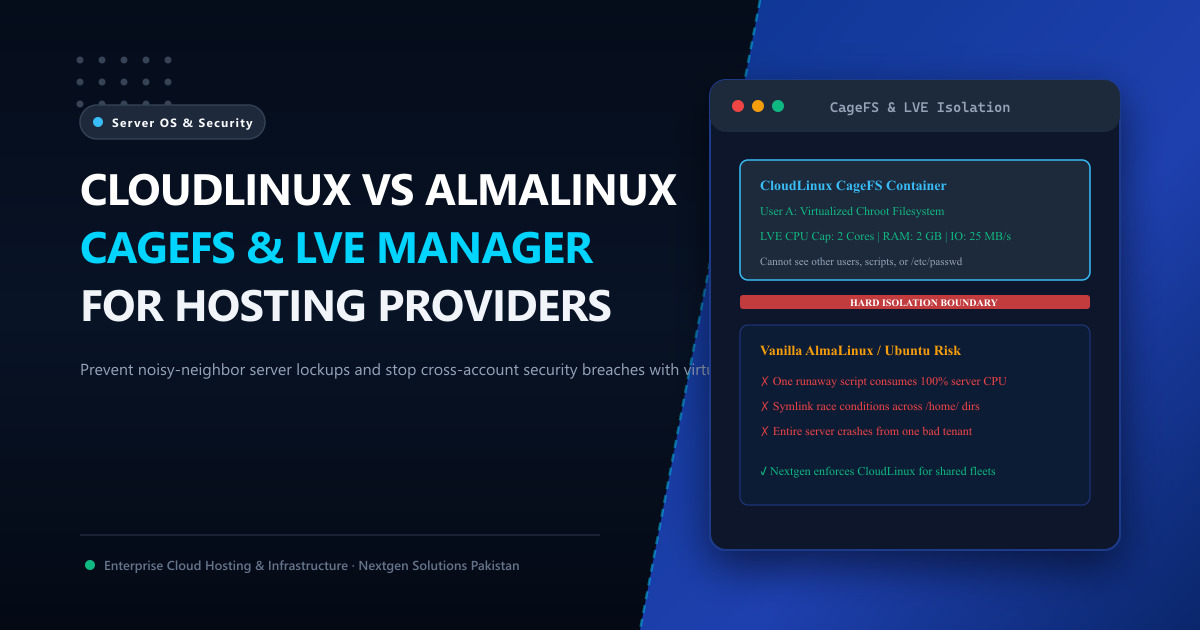
In a vanilla Linux environment, if a malicious hacker compromises a single WordPress site on a server, they can often navigate up the directory tree to /home/ and read file listings, inspect /etc/passwd, and look for configuration files containing database credentials.
With CageFS:
- Each tenant is placed inside an isolated, virtualized file system sandbox.
- Users only see their own files and a read-only skeleton of safe system binaries.
- Users cannot see any other user directories, running processes, or server hardware configurations.
- Even if an attacker gains shell execution inside User A’s account, they cannot pivot or execute cross-site symlink attacks against User B.
2. LVE Manager: Hard Limits on CPU, RAM & IOPS
CloudLinux utilizes Linux kernel namespaces and cgroups to create a Lightweight Virtual Environment (LVE) for every cPanel account:
# Example LVE Quota Enforced on Standard Shared Account
CPU: 100% of 1 Core (Can never monopolize the other 15 cores)
Memory: 2048 MB (Physical RAM cap)
I/O: 25 MB/s (Prevents disk saturation)
IOPS: 1,024 read/write operations per second
NPROC: 50 concurrent active processes
If User A’s site is attacked or runs a heavy automated script, only User A’s site slows down or displays a temporary 508 Resource Limit Reached page. The rest of the server continues operating at 100% speed with zero interruption.
3. MySQL Governor: Stopping Database Lockups
MySQL has historically been the primary cause of shared server crashes. When one customer executes an unindexed query on a 5-million-row table, MySQL locks tables and starves other users of database connections.
MySQL Governor monitors real-time CPU and I/O usage by database users. If a user exceeds their allocated threshold, MySQL Governor automatically throttles their connection using CPU scheduling priorities, preventing the MySQL daemon from ever becoming unresponsive.
4. HardenedPHP: Securing Legacy Client Sites
Pakistani web design agencies often manage clients who refuse to pay for redesigning 10-year-old custom portals running on PHP 7.1 or 7.2.
On vanilla AlmaLinux, running an end-of-life PHP version leaves your server vulnerable to known remote code execution (RCE) exploits. CloudLinux’s HardenedPHP backports modern security patches to ancient PHP versions, allowing legacy client sites to remain functional without endangering the server.
🏢 When Should You Use AlmaLinux Instead?
While CloudLinux is essential for shared, multi-tenant hosting, AlmaLinux is the superior choice for dedicated workloads:
- Single-Tenant Application Servers: If your company is running an internal ERP, fintech banking switch, or microservices architecture where you control all code on the server, paying for CloudLinux provides zero benefit.
- Dedicated Database Nodes: High-throughput MariaDB Galera clusters or PostgreSQL nodes need 100% unthrottled access to all CPU cores and NVMe controllers without LVE abstraction overhead.
For dedicated single-tenant workloads, deploying pure AlmaLinux or Ubuntu on Nextgen bare-metal Dedicated Servers in Pakistan delivers maximum raw compute power.
For multi-tenant hosting agencies, Nextgen provides turnkey CloudLinux installations on both Cloud VPS in Pakistan and enterprise bare-metal fleets.
📚 Related Technical Architecture Guides & Reading
- cPanel vs DirectAdmin vs CyberPanel: The 2026 Showdown – Compare control panel costs, features, and migration workflows.
- How to Use cPanel to Manage Your Web Hosting – Practical guide to managing files, databases, and SSL certificates.
- Proxmox VE vs VMware ESXi: The Broadcom License Escape Playbook – Virtualization architecture and bare-metal hypervisor design.
Deploy Hardened CloudLinux Servers in Tier-3 Datacenters
Protect your agency from noisy neighbors and server crashes. Nextgen provides turnkey Cloud VPS and dedicated bare-metal servers licensed with CloudLinux, CageFS, and cPanel/DirectAdmin in Islamabad datacenters.